Test Driven Development
By Srinesh Nisala (Senior Software Engineer @ iLabs)
1. Introduction to Vitest
Objective: Explore Vitest as a unit testing tool.
Key Topics
- What a test file looks like:
describe(),it()andexpect()
- Sanity check:
- Write a simple passing test to confirm the setup works
2. Hands-On Demo: Building a Password Validator with TDD
Objective: Implement a TDD workflow using Vitest.
Pre-requisites
- Create a Github account
- Get a fork of https://github.com/s1n7ax/lecture-tdd-v2
- Open the project with Codespace
Understanding the project structure
- Explain how to run tests
npm test
Write all tests first
- Create
password.jsandpassword.test.js - Write a test: short password returns
{ valid: false } - Write a test: 8-char password returns
{ valid: true } - Write a test: password with no uppercase returns
{ valid: false } - Write a test: password with no digit returns
{ valid: false } - Write a test: password with no special character returns
{ valid: false } - Run all tests — show all RED
Exercise
- Minimum length — Implement minimum code: check
password.length >= 8. Run tests — first two GREEN, rest still RED - Uppercase — Add the uppercase check (
/[A-Z]/). Run tests — show GREEN - Digit — Add the digit check (
/[0-9]/). Run tests — show GREEN - Special character — Add the special character check (
/[^a-zA-Z0-9]/). Run tests — all GREEN. Point out the smell:{ valid: false, message }repeated four times
3. Introduction to TDD
Objective: Understand the philosophy and purpose of TDD.
Key Topics
- What is TDD?
- Test-Driven Development (TDD) is a Software development method in which you write Automation Tests before the actual development process starts.
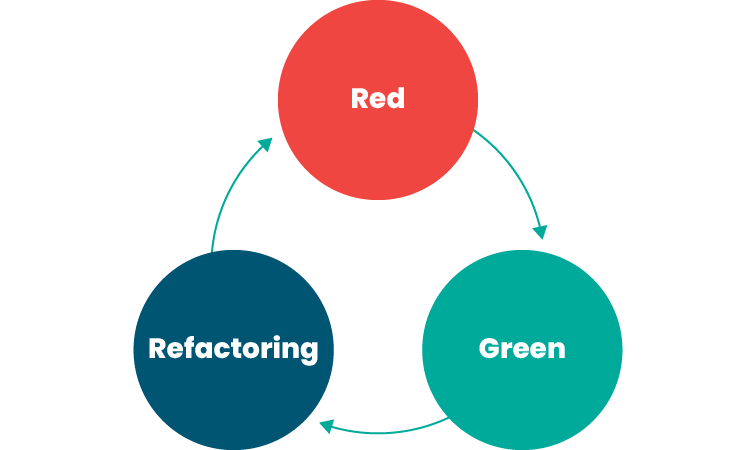
- Red-Green-Refactor:
- Focus on testing behaviors (requirements) rather than implementation details.
- Write minimal code to pass tests ("green").
- Refactor without adding new tests.
- Pros:
- Forces you to think about the interface before the implementation.
- Tests act as living documentation — they show exactly what the code is supposed to do.
- Gives confidence to refactor without breaking existing behaviour.
- Cons:
- Can give false confidence if tests only cover happy paths.
- Best Practices:
- Never write code without a failing test: You may only write new production code to pass a unit test that has already failed.
- Write minimal tests: Do not write more of a test than is necessary to fail. Compilation failures are considered test failures.
- Code to pass: Write exactly the amount of production code needed to satisfy the failing test, not more.